Showing posts with label Kangaroo Island. Show all posts

Kangaroo Island. Day 5

Dudley Peninsula
Itinerary: Prospect Hill - Emu Ridge Distillery - Cape Willoughby - Antechamber Bay - Penneshaw

The last day on the island was gloomy, windy, and grey. It felt like it was going to rain and it was weather for bidding farewell without too much regret! There was plenty of time before our ferry in late afternoon, so we ventured out for the last few hours in KI.

We climbed a steep wooden staircase leading to Prospect Hill. Captain Flinders used this spot as a lookout to map out the coast. This hill top offers panoramic views towards American River and Pennington Bay.

The view from Prospect Hill

In 4 days in KI I had noticed that eucalyptus oil had a cult status with the locals. Once a sprawling industry on the island, eucalyptus oil production employed over 600 people when it reached its peak in the 1930's. Today Emu Ridge Eucalyptus Distillery is the only commercial distillery in South Australia. It is the epitome of the KI spirit: the business is self-sufficient, operating on solar, steam and wind-power with all by-products being recycled. The process follows the same principles as decades ago - lots of manual labor.

A distillery employee walked us around the property that had been purchased by a sheep farmers' couple in 1991 who re-invigorated it to become KI's success story. The oil is distilled from the leaf of the indigenous bush - Narrow Leaf Mallee. One tonne of leaves make a 2-5 litres of oil that goes through 2 rounds of purification. The final result is transparent pungent liquid which can be used in countless ways (or so we were told)! Who knows maybe I'll join the ranks of the oil worshipers!?

We drove through Penneshaw having lunched at Marty's - a no-nonsense home-style cafe with great coffee and headed to easternmost point of KI - Cape Willoughby. Its light house was the first to be built in South Australia (1852). The isolation, ruggedness and beauty of this part of Kangaroo Island, is striking. Standing 27 metres high with 102 steps to the lookout tower, Cape Willoughby Lighthouse offers a stunning panoramic view across Backstairs Passage and the Kangaroo Island coastline. The Visitors' Centre is also a museum with artifacts and stories of shipwrecks, lighthouse keepers' families, etc.

Cape Willoughby

At Antechamber Bay in Lashmar Conservation Park that has long sandy beach perfect for swimming, the strongest in our family went for a swim. In Penneshaw we visited Dudley Wines cellar door, had a coffee and wine break at Penneshaw hotel, and finally, got on SeaLink to cross the 11km passage back to the mainland.

I felt mildly tired and very relaxed from having taken in so many sights unusual to a North American eye, having crossed KI's many roads, walked quite a few trails, and seen, tasted, and heard so much! We had enough time for exploration without being pressured to hurry. I'm sure there are places that we have missed and / or ran out of time to get there - it is hard to cover such a vast territory in 5 days, but even these 5 days were incredibly fulfilling.
Read more »

Kangaroo Island. Day 4

Exploring the beaches of North Coast
Itinerary: Western River Wilderness - Snelling Beach - Stokes Bay Beach

Waiting for the day to warm up, we headed to Western River Wilderness. A narrow winding trail took us on a 5km hike to a spectacular view of the Waterfall Creek. Although dried-up for the lack of rain, a deep canyon is nevertheless, very impressive. We walked on a trail covered with glistening minerals, through the forest, listening to the screeching of elusive black cockatoos. The Little Nomads stuffed their and the Big Nomad's pockets with granite and mica-dotted stones and were as happy as if they'd discovered a secret treasure cave.

Waterfall Creek trail in Western River Wilderness

The rest of the day was dedicated to exploring the two of the most amazing beaches on the north coast. They were very similar to Emu Bay beach in their isolation, beautiful wave-less waters, and exceptional sand. The roads leading to the beaches provide magnificent views but steep slopes and close ridges are not for nervous drivers.
Snelling Beach from
Constitution Hill
At Stokes Bay we stopped for late lunch at Rockpool Cafe - an unbelievably busy family-run place. The food was pricey but good and its location, 100m to the beach, is unbeatable! The only way to you can get to Stokes Bay beach is by walking through a arcade grey boulders. Once I emerged from claustrophobically-narrow rock alley, I got a nirvana moment - when I saw a fine, white, pristine beach surrounded by cliffs, a large rock-enclosed pool that provides protection from the surf, turquoise waters and... virtually, no tourists!
Stokes Bay
To finish the day we headed to the south coast's Vivonne bay jetty where the Little Nomad tried his hand at fishing. Soon it started to drizzle and we all wanted to go home to our BBQ that we had missed so much while staying in the city!

Read more »

Kangaroo Island. Day 3

From Central South to Central North
Itinerary: Little Sahara - Parndana - Emu Bay


Very close to Vivonne Bay, Little Sahara is a vast area of spectacular white sand-dunes surrounded by bush. Climbing over the first ridge you are confronted by a second, much higher dune, which reveals... even more dunes. We climbed on top of the first one and didn't even try to explore the vastness of the area! A nearby shop rents out sand boards and toboggans. The Little Nomads rolled in the sand and whooshed down the mountains on a board, which immediately reminded me of winter in snowed-in Ontario.

The first ridge of Little Sahara

Parndana is an area in central KI with a town by the same name. We drove to Parndana Wildlife Park, an award-winning, 2nd largest privately-owned park in SA.  The large property is a zoo, which contains a wide range of Australian, mostly KI, wildlife up close. Wallabies, kangaroos, talking cockatoos, crocodiles, etc. Feeding gentle kangaroos was definitely the highlight of the park!


We had lunch at IGA Bakery Cafe with home-like service and the scent of eucalyptus that they use for cleaning. It was my first time for a 100% Aussie burger with a slice of beetroot and an egg! Right after, we moved to Emu Bay on the northern coast.

En route there was Emu Bay Lavender Farm - where we stopped for a walk among rows of various types of the plant. It was pass harvest season, but there were still quite a few colouful clusters left. Although pretty, this KI field was a pale memento of the blooming lavender fields in Provence with their deafening sound of bees and the overwhelming scent! The cafe and shop sell everything lavender from hand-cream to bread and having got lavender ice-cream we settled outside by a little pond. And OH OH OH was is the most wonderful ice-cream! It was certainly home-made, creamy, but not heavy; traces of lavender added such nice texture and the scent was divine! Certainly, hadn't tasted this in Provence!
Lavender fields at Emu Bay Lavender farm

The north coast well-protected from harsh winds has a number of amazing beaches that are quiet, safe, and waves-free. Emu Bay Beach is one of KI's best swimming spots with 4km of spotless sand - the type of a beach that makes you say "wow". We spent the rest of our care-free the day there - swimming, fishing off the jetty, and watching pelicans feed.

Emu Bay beach
Read more »

Kangaroo Island. Day 2

Exploring Southwest
Itinerary: Kelly Hill Caves - Koala Walk in Hanson Bay Sanctuary - Flinders Chase National Park (Remarkable Rocks, Admiral Arch, Weirs Cove, Cape du Coedic)


We started the day by visiting Kelly Hill Caves at Kelly Hill Conservation Park. There is a folk tale of an unfortunate horse named Kelly that fell into one of many cave's sink holes in 1880. Kelsy, who rode Kelly, managed to climb out, but the horse stayed at the bottom.

The only way to explore these caves is with a guided tour. What we saw -  a maze of 5-6 caves full of halls, passages, impressive stalagmites, stalactites, and straws - is only 0.1% of the discovered area of 105 cave systems. Cave-explorers can spend 2-3 days at a stretch in the underground world that stretches 9km.

As a family adventure, this 30-45min tour was great! The caves were dim to give a feel of the cave world, the ranger was knowledgeable and entertaining, and the length was sufficient to keep the kids interested. There is a 2-hour caving tour for the more adventurous who would like to crawl and slide through narrow dark passages. 

Koala Joey at Koala Walk
Koala are very common in KI, literally falling off the trees. But the most remarkable koala encounter we had was at Koala Walk in Hanson Bay Sanctuary. Sitting low on a branch, there was an incredibly alert, fluffy, bear-like tiny joey, who couldn't take his eyes off of us - he was so interested! His sleepy mom sat close.

This little area lined with gum trees is home to many kangaroos, tammar wallabies, possums, echidnas and koalas, of course. We saw a number of bright-colored birds that I call parrots, but in truth were lorikeets, crimson rosellas, black cockatoos, etc.

When the koala population on the mainland was threatened with extinction, in the 1920s, 20-23 koalas were introduced to Kangaroo Island. They were so happy there, numbers grew in no time to 30,000 and they were chomping their way through the gum trees, their only food source, at an alarming rate. To control the population as well as save KI's delicate ecosystem, a sterilisation plan was introduced by the South Australian Government that is still in place.

The next stop was Flinders Chase National Park that boasts of the most remarkable attractions in KI. Before venturing any further we had al fresco lunch at the park's Chase Cafe. While the Nomads busied themselves in the kids' archeological dig, the Big Nomad and I made a quick walk along the Discovery Trail.

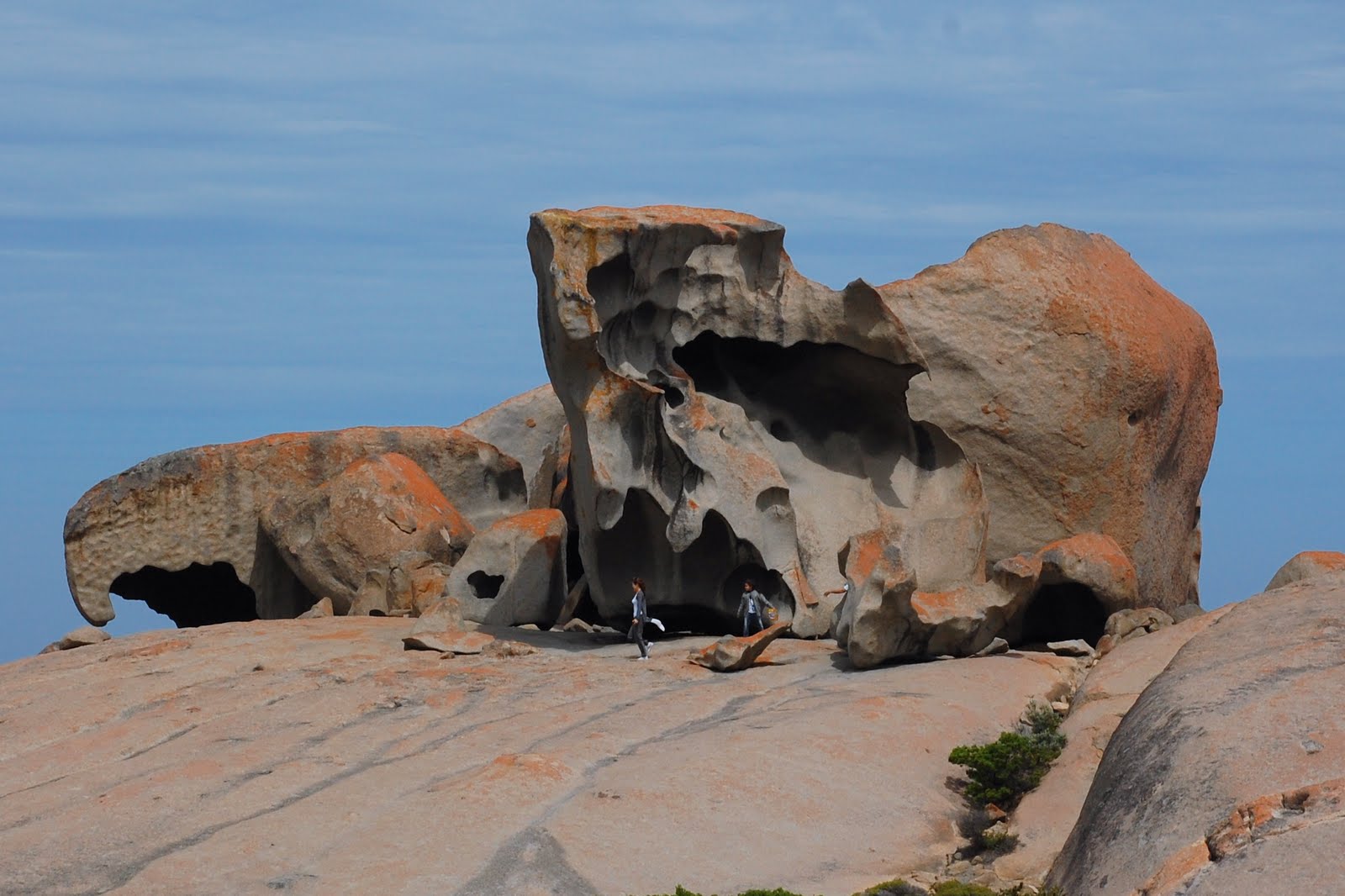
Remarkable Rocks
Remarkable Rocks at Kirpatrick Point was our next destination - these beautiful wind-sculpted rock formations sit atop a smooth granite dome. Slippery southern slopes are only 75m above the ocean and there were a few accidents when people were washed off the rocks at high tides and strong waves. Taking precautions and holding the Nomads' little hands were a much bigger concern than the beauty of the rocks.

We made our way further west, along the most southern road on KI, which runs along the edge of the cliff to Cape du Coedic. The road opens sights of spectacular steep cliffs and emerald waters of the bay. En route we stopped at Weirs Cove to see remnants of a store room and a flying fox structure, that brought supplies up the cliffs for the lighthouse's family starting in early 1900s. The steamer came here once in 3 month.

Cape du Coedic with
Casuarinas islets and Admiral Arch opening
At Cape du Coedic we started a 5-km hike through low-growing bush. We soon reached the 1906 lighthouse perched atop wild and remote point. This brutal coastline, underwater reef cutters, two islands (the Casuarinas) extending some 35-40 km boast 14 shipwrecks!

A boardwalk leads down to yet another couple of landmarks: the rugged cliffs and natural rock pools are a favorite spot of New Zealand fur seals. We descended to Admiral Arch - a spectacular arch-way formed by pounding seas and strong winds. The seals here are only 30m away - frisky, playful, and so smelly!

This isolated point with seal-covered rocks, harsh winds, damp air, acrid smell of animals felt so wild and so remote! I couldn't help but wonder how any human could make his living there, let alone a family with children!

We climbed back to the top of the cliff and made our way back through the rest of the trail.

New Zealand fur seals at Cape du Coedic
Admiral Arch

We were back at the cottage by 6pm to catch the evening sun and waves at the beach. After another rustic dinner we sat by the fire pit and once the night fell, we ventured into complete darkness of KI with flashlights, hoping to see nocturnal wildlife action. The Little Nomads' loud voices didn't entice any wild animals to come out and after this self-guided nocturnal walk and a long day, the kids were fast asleep.
Read more »

Kangaroo Island. Day 1

Itinerary: Penneshaw - Kingscote - Seal Bay Conservation Park - Vivonne Bay 

SeaLink moving from Cape Jervi
SeaLink ferry (that has complete monopoly over water transportation to/from KI) took us from Cape Jervis across Backstairs passage in 45 minutes. We drove through Penneshaw (the first of the two most populated areas of the island) to the Penguin Centre. Apparently, the little penguins that make home on the rocky shores of the town, leave the coast in summer to fatten up for winter and get back to the island in the fall. So we headed to Kingscote, a neighboring second largest town for a gas and stomach fill-up.

We got a take-away seafood basket at KI Fresh seafood cafe and settled at a picnic area at a playground overlooking the shore. The food was simple and fish very fresh, good enough for takeaway, but nothing spectacular as you'd expect. While the Little Nomads, fed on local specialty - battered and crumbled whiting and snapper fillets, hopped around the playground, the Big Nomad and I went down to the jetty to discover colonies of birds: cormorants, pelicans, and others I couldn't identify. Apparently, a daily 5pm feed takes some planning on the birds' part and some of them were there 3 hours in advance!

The queue awaiting supper

Driving south to our cottage in the centrally-located Vivonne Bay took about 40 minutes. There are only 2 major asphalt roads on KI, crossing it from east to west, both going to/from Flinders Chase National park. The rest are minor unsealed roads (make sure you have a well-cushioned seat) that take you through farms, bushland to rugged coastlines and quiet bays. These are routes to discovery of incredibly varied landscape with many animals and birds crossing your way.

En route, we stopped a small sheep farm - Island Pure Sheep Dairy, which makes organic products from sheep milk. We tasted a few varieties of cheeses, yogurts and purchased some Manchego and mango yogurt. Fast-forward to the next morning when we opened the yogurts, we unanimously agreed it was the best yogurt the Big Nomad and I had had!

Seal Bay
Having dropped off our things at the cottage, having ahhh-ed and ohhh-ed at it, we headed to Seal Bay Conservation Park. Walking out of the visitor's centre, you catch a beautiful sight of the bush-covered hill rolling into white dunes and into the wavy ocean, peppered with black and brown dots of sea lions and seals. A boardwalk takes you down close enough to the sandy area with the resting seals. Coming down we had heard screeching noises, barks, screams, and some commotion at the beach and by the time we got down we saw a wounded male seal, badly bitten by another male. A guide told us that it'd most likely not survive and the conservation park staff did not interfere with the course of nature.

A few minutes after we joined a group for a guided walk  (for a fee, of course) with a hoarse-voiced exhausted-looking ranger (it was the end of the day), who took us down to the seal beach for a close-up look (and smell) of the animals. The colony is made up of about 500 animals with 100 seals resting after a 3-4 day hunt in the ocean and the rest at sea. It is the end of the breeding season and most female lions were accompanied by the cutest awkward pups.

10 minutes into the tour, the Little Nomad got pretty bored by seal life stories. He dropped in the sand and started digging. A close-by seal mom had watched him intently and then, all of a sudden, rose and started moving fast toward the Little Nomad, followed closely by a little pup. The tourist group froze for a few short seconds not knowing what to do. We had been told these awkward-looking animals ran faster than humans on sand and are quite aggressive when defending their young. The ranger told us to move swiftly but not run. We backed out slowly, 5m away from the mom who was waddling her way straight to us (in our hurry and confusion we left the plastic water bottle that can be see on the photo). Finally, the mom stopped and dropped herself into the sand hole dug by the Little Nomad. She wiggled a bit making herself more room and closed her eyes. We offered the ranger to hire the Little Nomad as an official Seal Holes Digger, but as I had said before they didn't interfere with the seals' lifestyle...


A pup looking for mom

Vivonne Bay beach
It was around 5pm by the time we climbed back to the park's centre. The Little Nomads were getting restless (a sure sign of tiredness) and the Big Nomad was ready for one of the succulent steaks we brought in the cooler. It is recommended to get off roads by dusk to prevent wildlife accidents. So we headed back to our cottage at Vivonne Bay. Its beach was proclaimed the best in Australia by a University of Sydney's professor and the expression caught on. It is also a fishing hot spot with many fishing boats and antlers trying their luck by the jetty.

The cottage was 200m away from the Bay and we could hear the waves breaking at the shore every single night. With its white sand and turquoise water, the beach had stronger waves that I had expected, but safe enough for the Nomads to enjoy jumping over them and swimming. Happy and hungry we came back to the cottage, fired up a BBQ and had a terrific simple dinner with salad, steak, and Dudley wine.

LaViv - the cottage where we stayed has many terrific features: besides its great location with proximity to the beach, it carries the character, heart, mind, and soul of people who built it. I felt like I was in my friend's guest house, rather than a faceless cottage where you'd stay and won't remember. It embodies the spirit of KI - eco-oriented, personable, creative, unique, and hospitable. When Cathy, the owner, stopped by she told us a bit the history of its construction, with her husband having planned, crafted, and built, she - putting in the finishing touches, and 3 kids pitching in when and how they could. There's also photo album that highlights the construction and I could feel that the owners truly love and care for this house.

The hours I had spent searching for accomodation in KI were not in vain - I can hardly think of a place, which would have enhanced our experience and our perception of the character of the island more! Aside from an obvious creative craft streak throughout the house, every nook and corner had surprisingly thought-through details. The line of organic products for all cases, KI eucalyptus oil for cleaning, KI honey and teas, tubs of lego, toys and books, dozens of elclectic cds, and dvds (which we haven't used) - there were so many niceties that would make time freeze - the exact reason why people come to KI!

Hand-carved rock by the entrance
Sun Room
Read more »

Kangaroo Island 101

Kangaroo Island (KI) is mere 13km off the coast of South Australia across Backstairs Passage. Its area of 155km x 55km is a micro-universe of mega-fauna: different landscapes and environments offering an amazingly pristine land with wildlife wonderland, dunes, spectacular scenery with emerald ocean waters and sandy beaches, rugged mountainous coastline, forests, and bush.

KI was separated from mainland Australia by a rise in sea level over 9,000 years ago. Aboriginal people occupied the land at least 11,000 years ago; however, they disappeared in 200 BC. The exploration of the island is attributed to a Frenchman Nicholas Baudin. Shortly after, his English counterpart Captain Mathew Flinders named the island after his crew feasted on kangaroo for the duration of their 4-month exploits.

A collection of whalers, sealers, convicts and deserters made their home here and in the early 1800s. Soon KI a reputation of the most lawless and vicious places in the British Empire till 1827 when the worst offenders were captured. The island developed slowly with an estimated population of 1,113 in 1947. But after the end of World War II, the Government established a War Service Land Settlement Scheme where ex-soldiers would be settled and encouraged to farm the undeveloped land on the Island's central plateau. 174 soldier settlers and their families came to the Island, and by 1954 the population had increased to 2,167. Currently, the island is home to about 4200 residents.

Snelling Beach on the north coast

In the past few decades, KI re-emerged as a top eco-tourism spot. 1/3 of the island is under fierce protection of either national or conservation parks. They offer the state’s best opportunity to view and interact with unique Australian native wildlife. The island’s local produce is a unique as its wildlife and includes (but isn't limited to) honey produced by a pure strain of Ligurian bees (a gentle Italian bee that was first brought to the island in 1884 from Liguria), jams from indigenous fruits, sheep-milk cheeses, local wines, eucalyptus and emu oils, etc. Many residences are self-sustaining, running on solar batteries and rain water. I also got a sense of a tight community with most restaurants and stores using locally-made oils, soaps, and other similar products, offering fish freshly-caught themselves or by a neighbour, meats from a local farm, and serving wine from the next-door winery.

Rugged Cliffs of Weirs Cove

Read more »