Showing posts with label wine. Show all posts

Top things to do around South Australia

In no particular order
  1. Get a dozen of freshly-caught oysters and a chilled bottled of Barossa bubbly, sit at the beach and enjoy the sunset at Glenelg.
  2. Window-shop on Jetty rd, have a latte, and look for stingrays off Glenelg jetty. Relax at the beach, swim, and do nothing!
  3. Jog from Glenelg jetty to Brighton jetty and back and take a swim in the Bay. 
  4. Visit Adelaide's many museums and take part in its many festivals.
  5. Hike in Hallet Cove.
  6. Swim with dolphins off the coast of Glenelg.
  7. Tour Barossa and taste shiraz. Have alfresco lunch at a rustic Charlie Melton winery in Barossa. 
  8. On Sat afternoon head to the Central Market and hunt for great deals on freshly-caught fish, shellfish, fruits, and veggies. Grab a sizzling platter for lunch at the food court.
  9. Visit Remarkable Rocks, Admiral Arch, Seal Bay Conservation park, swim at Stokes Bay or Snellings beaches of Kangaroo Island. Feed kangaroos at Prandana. 
  10. Treat yourself to lavender ice-cream at Emu Bay Lavender Farm on KI. 
  11. Take an airplane tour to view Wilpena Pound from the air.
  12. Take a 4WD tour in Arkaroola.
  13. Bushwalk to St. Mary's Peak at Flinders Ranges National park and enjoy the stunning view.

Read more »

Fleurieu Peninsula, SA

Fleurieu Peninsula is a picturesque triangle of land located south of Adelaide, some 20km to McLaren Vale and about 70km to the southern tip of Victor Harbor. Named after the French explorer and Napoleon's navy minister Charles Pierre Claret de Fleurieu in 1802 (by another French explorer Nicolas Baudin... talk about kissing up), this area is famed for its coastal thrills, secluded beaches, gourmet foods, wineries,  and unspoiled wildlife.

It's a paradise for divers and snorkelers, with dramatic shipwrecks and stunning marine life. McLaren Vale is home to over 60 vineyards, which, by some, are considered the best in the country.

The bus first took us up to the Adelaide Hills, which technically, is not a part of the Peninsula, but spectacular, nonetheless. Having spent 15 min trying to spot elusive koalas in the natural habitat, we headed off to a historic village of Hahndorf.

A view from Adelaide Hills

Fleeing religious prosecution in Prussia, 50 German Lutherans came here in 1859, mostly farmers and laborers with their families. The oldest-surviving German settlement in Australia, Hahndorf is a quaint village, lined with antique shops, cafes, and gourmet food shops, and a few traditional half-timber Germanic houses. The Beerenberg gourmet foods is one of the well-known family-owned production of fine foods, mustard, jams, preserves, relishes, that has been in business for over 150 years.

Hahndorf was named after Hahn, the Dutch captain of Zebra,
which brought the first Germans here


Taking a scenic route, we passed through Mount Barker and Strathalbyn. The latter was founded by Scottish settlers, just two months after the establishment of Hahndorf. Local municipality with a vision has preserved the main streets, complete with blue-stone buildings, which now make up a terrific walk. Known for excellent antique stores, galleries and fine craft shops, this lovely village is perfect for aimless wandering!

Moving further south, we headed to Goolwa, a point where Australia's largest river - Murray, meets the ocean. The state's first railway line was built here to move cargo to Port Elliot. 

Oscar W steamboat- the authentic, 102-year-old, wood-fired paddle steamer
still operational today at Goolwa


The muddy waters of the Murray River after 2 days of rain
The Murray River is Australia's greatest river that snakes down 2,520km from the Snowy Mountains to the Southern Ocean. It is a vital source of irrigation in four of Australia's states, as well as water supply to most towns along the river, and many further away through various pipelines.

The Murray Mouth is the point at which the Murray River empties into the ocean. Since the early 2000s, special machines have moved sand from the channel to maintain a minimal flow from the sea and into the Coorong's lagoon system. Without it, the Mouth would silt up and close, cutting the supply of fresh sea-water into the Coorong, which would then warm up, stagnate and die.

The map of Murray Mouth

Moving west through bohemian Port Elliot, we reached a popular holiday destination and South Australia's retirees' paradise, a town of Victor Harbor. It has about everything for a holiday - the sun, surf, sand, stunning views and wildlife, colonial architecture, gourmet restaurants, and nearby wineries. It is a popular whale-watching destination during the mammals' mating and breeding season, May-October.
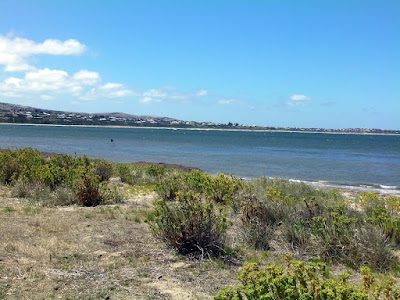
Ocean at Victor Harbor
Whale Discovery Centre

The town is protected from the Southern Ocean by Granite Island, connected to the main land by a causeway. The 1894 horse-drawn double-decker tram takes visitors to the Island, which is also home to a colony of little penguins.

Granite Island across the bridge

A horse-drawn tram

With around 76 winery cellar doors, McLaren Vale is the largest and closest to Adelaide of the two Fleurieu Peninsula's wine regions. The bus driver told us that a general perception of the Vale is of a non-commercial, family-owned, your 'mom and dad' vineyards as opposed to the corporate Barossa. A few years ago, the Hardy's group's ownership moved back to Australia from the US. The pride I heard in his voice was similar to a wave of corporate patriotism around the country when Tim Hortons changed ownership from American to Canadian.

Shiraz is a specialty, as are Cabernet Sauvignon and Grenache, while Merlot is becoming increasingly popular as a varietal. Chardonnay dominates the white varieties but Sauvignon Blanc and Riesling are also gaining kudos, and experimentation is taking place with Viognier, Marsanne and Sangiovese.

McLaren Vale
Wine-tasting at Hardy's was quite interesting and satisfying
Read more »

Sightseeing in Adelaide (with kids), part 2

GREEN SPACES

1. Adelaide Zoo - located in the centre of city, on the edge of the university campus has around 1400 exotic and native mammals, birds and reptiles. The highlight of the zoo is a newly-acquired couple of pandas. They have definitely become the zoo's mascots.


A surrikat
A thoughtful wallaby


2. Botanic Gardens -  is a 125-acre (51 ha) public green space established in 1854. It is easy to forget about the hassle of city in this quiet setting of native and exotic plants, pavilions, and exhibits.


MISC

National Wine Centre of Australia built in 2000 as a joint State and Federal Government venture, the building is being leased to the University of Adelaide for 40 years. Here you can enjoy wine and winemaking from the ground up.  The interactive Wine Discovery self-guided tour and exhibition showcase the complete wine experience. The cafe offers a wine tasting menu with options to appease a connoisseur. The attractive and unusual building is also a home for many events functions, as well as wine appreciation classes, wine training, and weekly 'wine-down hours'. 

The shop at the Wine Institute
Wine Cellar
 
Rundle Mall is probably, it is one of the most-recognized streets in Adelaide, it is a 500m pedestrian area that concentrates more than 500 retails stores, boutiques, and arcades. A walk down the street is a treat for kids - with ice-cream or smoothie in hand, they enjoy the bronze sculptured pigs, the fountain, the Mall Balls, and the performers.

Read more »

The First Day in Lille

We arrived in Lille in the afternoon. Having taken 2 moderately smooth AC flights with the Little Nomads, we picked up our 4 suitcases and walked out of Gare Lille Flanders to the sight of the oddest exterior design of the Crown Plaza hotel.

The house, located in north Lille, was a 15-minute drive from the station. The 'house help' or the 'servants' house (as I called it), where we will live for the next 3 months, is quite lovely. It is a part of an impressive residential structure built in a traditional style of the 17th-century Flemish architecture.  Three distinct buildings constitute a square (with entrance gates on the fourth side): the main house or what I call the chateau, the 'house-help' quarter where we live and the 'stables' on the other side (now converted to another living quarter with three garages). A spacious courtyard is private, laid with large cobble stone.

The courtyard of the residence. Our 'house' is located on the left

Both owners speak impeccable English. The wife has an air of a relaxed golf-playing soccer-mom than a proud mother of many children and sounds like a graduate of an elite private English boarding school.

I spent some time creating as much of an open-concept as I could in our 2 bedrooms, which are decorated in a classic Provencal style. I cleared out countless knick-knacks, trays, vases, lamps, miniature sculptures, stacked numerous little coffee tables, cute chairs, etc. These details are quite lovely but not in a household with two extremely active boys!

Apparently, the modern open-design concepts are extremely contagious! I feel that I prefer IKEA furniture much better to the heavy wooden chiffoniers, closets and cupboards hand-painted with pastorals of palaces and fields. I guess I'm not much into antiques either...


The Impression of the day. God, wine is cheap here!
A terrific 5-EU bottle of Loire valley Cabernet Franc made me cry. It was beyond good! The dry sausage was a great accompaniment and we were done with both quite quickly. It will take a while till I get used to the wine and cheese prices here but I'm afraid the reverse transition will be much harder.
Read more »